1. Introduction: Rethinking Asset Allocation Beyond Capital
Most portfolio strategies begin with capital. Split it 60/40, divide it between stocks and bonds, maybe adjust based on age. This works—to an extent. But it assumes that equal capital allocations result in balanced portfolios. In reality, they don’t.
This is the problem that Risk Parity was designed to solve.
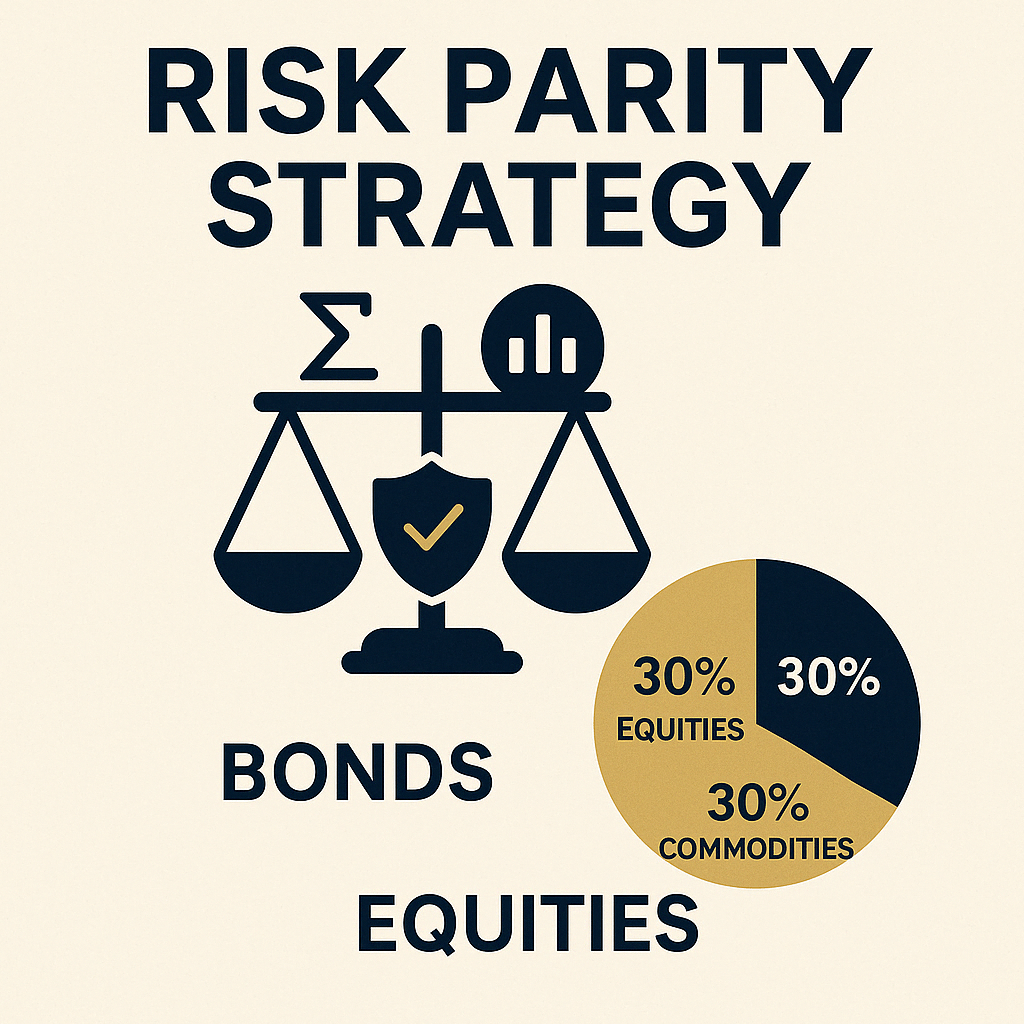
Risk Parity doesn’t split capital evenly. It redistributes risk—structurally. It seeks to equalize the volatility contribution of each asset class so that no single asset dominates performance, for better or worse.
Popularized by institutional investors and hedge funds like Bridgewater Associates, Risk Parity is not a prediction-based model. It is a structural design—one that begins with a simple insight: a truly diversified portfolio is not one that spreads capital evenly, but one that balances risk across assets.
In this part, we unpack the theory, implementation, benefits, and limitations of Risk Parity—and why it matters for long-term, risk-aware investing.
2. The Fundamental Problem with Traditional Allocations
A classic 60/40 portfolio might look diversified. But in risk terms, it’s anything but.
Equities are far more volatile than bonds—typically by a factor of three or more. This means that even though bonds make up 40% of the capital, they contribute very little to the portfolio’s overall risk. In most cases, over 85% of the total volatility comes from stocks.
So what happens when stocks fall hard? The 40% bond allocation, despite its size, cannot absorb the blow. The portfolio crashes with equities. And diversification turns out to be an illusion.
Risk Parity confronts this head-on. It doesn’t try to guess which asset will perform. Instead, it asks: how much risk does each asset bring to the structure? Then it reallocates capital until each asset contributes equally to total volatility.
If equities are three times as volatile as bonds, then the model allocates more capital to bonds—and less to stocks—until their risk contributions are balanced.
3. How Risk Parity Works: Equalizing Volatility Contributions
Here’s how Risk Parity builds a portfolio step-by-step:
- Estimate Volatility: Calculate historical volatility for each asset class—usually using standard deviation.
- Measure Correlation: Determine how asset classes interact. Correlation affects how their risks combine.
- Assess Risk Contribution: Use mathematical tools (partial derivatives of variance) to see how much each asset adds to total portfolio volatility.
- Reweight Capital: Allocate more capital to low-volatility assets, less to high-volatility ones, so that all assets contribute equally to risk.
- Apply Leverage (If Needed): Because lower-risk assets like bonds dominate the mix, expected returns can fall. Many Risk Parity portfolios apply moderate leverage to restore return targets.
The final portfolio typically holds equities, bonds, commodities, and other diversifiers in a structure where no single asset can destabilize the whole system.
4. Economic Regimes and All-Weather Thinking
Risk Parity isn’t just a numbers exercise. It reflects a way of thinking about economic change.
Bridgewater’s “All Weather Portfolio” is the most famous Risk Parity model. It was designed to perform under four macro regimes:
- Rising Growth – Favoring equities
- Falling Growth – Favoring long-duration bonds
- Rising Inflation – Favoring commodities and TIPS
- Falling Inflation – Favoring bonds and some equities
To prepare for all four, the All Weather Portfolio spreads risk across assets that each respond differently to these scenarios. One common model looks like this:
- 30% Equities
- 55% Bonds (mix of durations)
- 7.5% Commodities
- 7.5% Gold
This portfolio is often leveraged 1.5x to match the return potential of more aggressive portfolios like the traditional 60/40.
The result? A structure that seeks to perform, or at least survive, in every season—not just the sunny ones.
5. Advantages of the Risk Parity Model
a. Risk-Based Diversification
Risk Parity doesn’t assume diversification—it measures it. By balancing risk across assets, the portfolio becomes structurally diversified. No single macro scenario dominates.
b. Higher Risk-Adjusted Returns
Backtests and empirical studies show that Risk Parity portfolios often produce higher Sharpe Ratios—more return per unit of risk—compared to traditional models.
c. Drawdown Protection
In crises where equity-heavy portfolios collapse, Risk Parity’s overweight to bonds or commodities can cushion losses and preserve capital.
d. Structural Flexibility
Risk Parity is adaptable. It can include TIPS, REITs, international bonds, alternative premia, or volatility overlays—while preserving its core principle: risk balance.
6. Practical Implementation and Tools
Building a true Risk Parity portfolio requires math: volatility estimates, correlation matrices, and ongoing adjustments. But modern tools make it feasible.
Tools for Implementation:
- Portfolio Visualizer: Free online platform for backtesting and allocation
- Python/R Libraries: QuantLib, PyPortfolioOpt
- ETFs:
- RPAR Risk Parity ETF (RPAR)
- UPAR Ultra Risk Parity ETF (leveraged)
- AOR / AOM (multi-asset but not pure Risk Parity)
DIY Simplifications:
- Allocate more to low-volatility assets like bonds
- Include inflation hedges like gold or commodities
- Watch for correlation shifts and rebalance accordingly
Risk Parity can be exact—or approximated. Either way, the logic holds.
7. Key Risks and Criticisms
a. Assumes Stable Correlations
Risk Parity assumes that asset relationships stay consistent. But in stress periods—like 2022—stocks and bonds can fall together, disrupting the risk balance.
b. Leverage Magnifies Pain
Using leverage to boost returns works—until it doesn’t. If both equities and bonds decline, a leveraged Risk Parity portfolio can suffer severe drawdowns.
c. Complexity
It’s not plug-and-play. Rebalancing, forecasting volatility, and managing correlations require effort—or tools.
d. Cost
Risk Parity ETFs often charge higher fees. DIY approaches demand time, technical skill, or software support.
8. Case Study: 2020 vs. 2022
Let’s compare two very different years.
- 2020: In the March crash, stocks fell fast—but bonds and gold rallied. Risk Parity portfolios with strong bond exposure outperformed equity-heavy portfolios.
- 2022: Inflation spiked. Central banks hiked rates. Both stocks and bonds fell together. Risk Parity portfolios—especially those with leverage—suffered double-digit losses.
This contrast reveals a truth: Risk Parity is not immune. It does well when assets diversify each other—but it struggles when everything moves in sync.
9. A Modified Approach: Adaptive Risk Parity
To deal with real-world risks, many investors now use adaptive Risk Parity models:
- Use forward-looking volatility models (e.g., GARCH, EWMA)
- Adjust correlation matrices over time
- Overlay regime-based risk controls
- Add tail-risk hedges (e.g., puts, volatility swaps)
These adaptations increase structural resilience while preserving the original goal: balanced risk, not balanced capital.
10. Final Thoughts: Structure Over Prediction
Risk Parity is a bet on structure, not foresight.
You don’t need to know what the economy will do next. You just need a system that works across many scenarios. That’s the promise of Risk Parity.
Yes, it’s complex. Yes, it’s imperfect. But it solves a problem most portfolios ignore: risk imbalance hidden beneath capital balance.
For investors who care more about compounding than guessing, Risk Parity offers a blueprint—not a miracle, but a method.
In the next chapter, we’ll take this structural philosophy further by exploring the Core-Satellite strategy—a model that blends automated resilience with personal conviction, helping investors balance discipline with flexibility.





 HOHO-ECONOMICUS Insight
Leave a comment