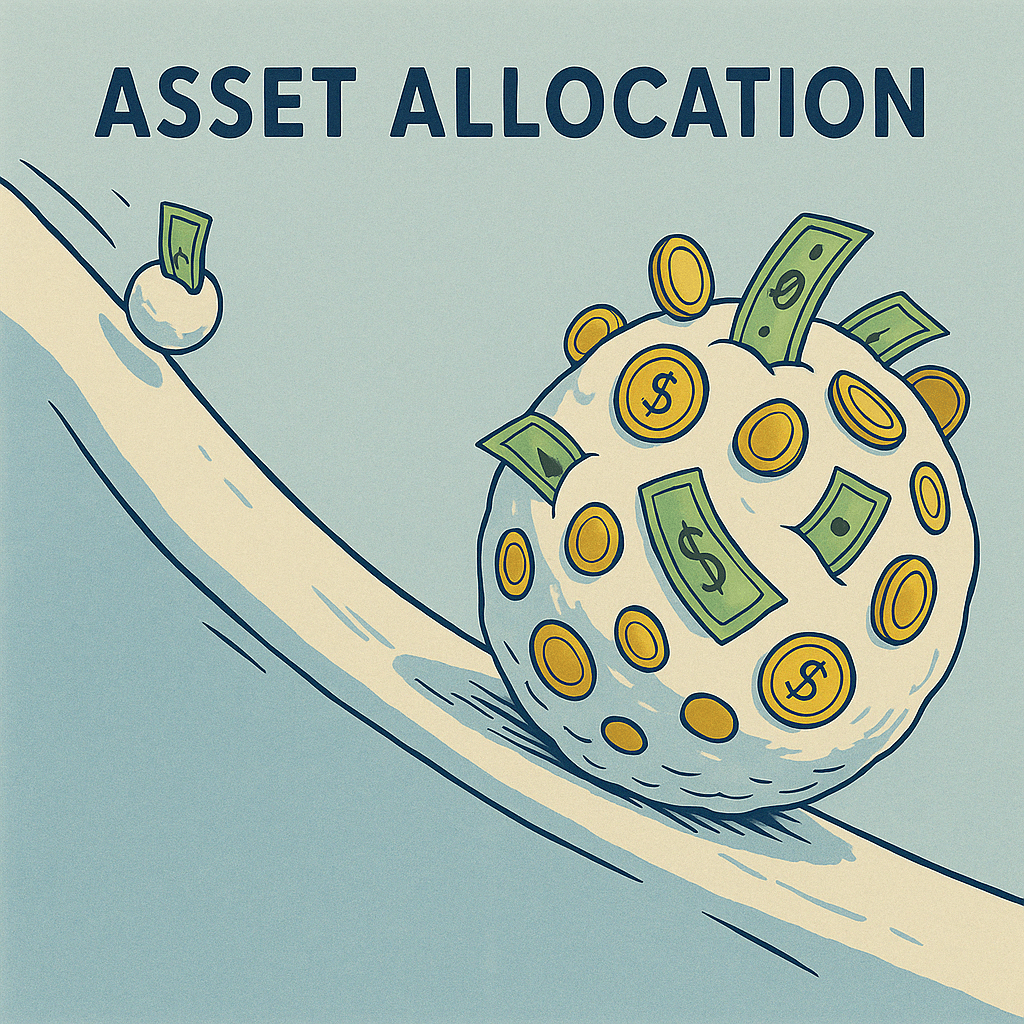
You are standing somewhere right now. But where exactly are you standing in terms of your asset structure?
That’s not a poetic question. It’s the most practical starting point for any investor.
In a world full of predictions, volatility, and noise, most people are focused on the wrong question: “What should I buy now?” Instead, the right question should be: “What kind of structure am I standing on, and is that structure built to survive and grow over time?”
This blog series is designed to help you build that structure—the kind that doesn’t collapse with market news, doesn’t shake under short-term price movements, and doesn’t rely on your ability to predict the future. Because here’s the simple truth:
Compounding wealth isn’t about chasing returns. It’s about building a structure that can survive.
And that’s exactly what strategic asset allocation is all about.
Why This Series Exists: From Market Noise to Structural Thinking
Asset allocation is often misunderstood as just splitting money into different investments. But in reality, it’s a sophisticated and deeply personal strategy—an architecture of resilience.
This series walks you through that architecture, not with complicated jargon, but through logical and actionable steps. Whether you’re a complete beginner or an investor with experience, you’ll learn how to transition from guesswork to structure, and from short-term thinking to long-term compounding.
At the heart of this series lies one powerful message:
Don’t try to predict the market. Build a system that doesn’t need to.
You don’t have to get every decision right. You just have to get the structure right—and stick with it.
Let’s take a quick look at what you’ll find in each part of this series.
[Part 1] The Basics of Asset Allocation and Traditional Asset Classes
We begin by grounding you in the fundamentals. What is asset allocation? Why does it matter more than picking stocks? What roles do stocks, bonds, and cash play?
You’ll understand how each of these traditional assets interacts with risk and return, and why the first decision in investing isn’t what to buy, but how to divide your capital structurally.
You’ll get answers to questions like:
- Why is asset allocation responsible for over 80% of long-term returns?
- Why is diversification more about survival than performance?
[Part 2] Alternative Assets: Real Estate, Commodities, and Crypto
Here, we explore what happens when traditional assets are no longer enough—when inflation, policy shocks, or geopolitical risks hit.
This part introduces real estate, commodities like gold and oil, and even cryptocurrency. Each of these plays a unique role in protecting your structure when traditional markets falter.
Learn how to:
- Use gold as a shock absorber
- Leverage real estate as an inflation hedge
- Understand crypto as a satellite asset—not a core
[Part 3] The 60/40 Strategy: Why Simplicity Still Works
The classic 60% stocks / 40% bonds portfolio may sound outdated, but its structure tells a timeless truth: simplicity can be powerful.
You’ll learn the logic behind this structure, its historical performance, when it works well, and when it doesn’t. This chapter is especially helpful if you’re overwhelmed by too many options and need a time-tested starting point.
You’ll explore:
- Real-world backtests of 60/40 portfolios
- The role of rebalancing and how it boosts compounding
- When to modify the 60/40 and what to replace it with
[Part 4] Risk Parity: Allocating Capital by Risk, Not Dollars
Here, we move into advanced structural thinking. Risk Parity is a strategy that gives equal weight to the risk contribution of each asset—not the capital invested.
This helps solve one major problem: traditional portfolios often look diversified on paper, but in reality, most of the risk is concentrated in stocks.
You’ll learn:
- How to measure risk contribution
- Why leverage is used and how to manage it responsibly
- How to construct a risk-parity-inspired portfolio using ETFs
[Part 5] Core-Satellite Strategy: Balance Structure and Flexibility
This strategy gives you the best of both worlds: a solid, automated core built for long-term growth, and a flexible satellite layer to express personal ideas or take strategic bets.
It’s ideal for investors who want to avoid emotional mistakes while still having room to experiment responsibly.
You’ll understand:
- How to build a 70/30 Core/Satellite structure
- What makes a good “core” vs a good “satellite”
- How to rebalance without breaking the system
[Part 6] Global Diversification: Expanding Beyond Home Bias
Many portfolios are too domestic, too narrow. Global diversification introduces resilience by reducing exposure to any one country’s economic shocks.
You’ll learn how to combine regional ETFs, foreign currency assets, and global bonds to create a portfolio that can thrive even when your home market doesn’t.
Explore concepts like:
- Currency hedging
- International inflation risk
- Country-specific regulatory risk
[Part 7] Personalized Asset Allocation & Real-World Tools
All of this theory must now become practice.
This chapter helps you apply everything to your real life. Based on your goals, time horizon, and emotional resilience, you’ll learn how to build, automate, and maintain a customized strategy.
Learn how to:
- Choose the right ETFs
- Use robo-advisors or manual systems
- Track your portfolio’s performance and adjust
[Conclusion] Structure Survives. Compounding Follows.
The final post brings everything together.
It reminds you that the key to wealth is not brilliance or timing—but consistency and structure. It walks you through a checklist to help you confirm whether your strategy is structurally sound, sustainable, and emotionally repeatable.
In a world that constantly changes, structure is your edge.
Why You Should Follow This Series
This isn’t a collection of random tips.
It’s a curriculum.
Each post builds on the one before it. Each strategy is tested, contextualized, and designed for real investors facing real uncertainty.
If you’ve ever felt overwhelmed by the market… If you’ve tried timing the news cycle and failed… If you’re tired of emotion-driven investing and want a system that lasts…
This series is for you.
So now, back to our first question:
Where are you standing right now, and what structure are you standing on?
If you’re not sure—or if you want to make sure your structure survives what’s coming next—then keep reading.
Let’s build a portfolio not based on luck or prediction, but on logic, structure, and long-term compounding.
Because markets lie.
But structure tells the truth.




 HOHO-ECONOMICUS Insight
Leave a comment