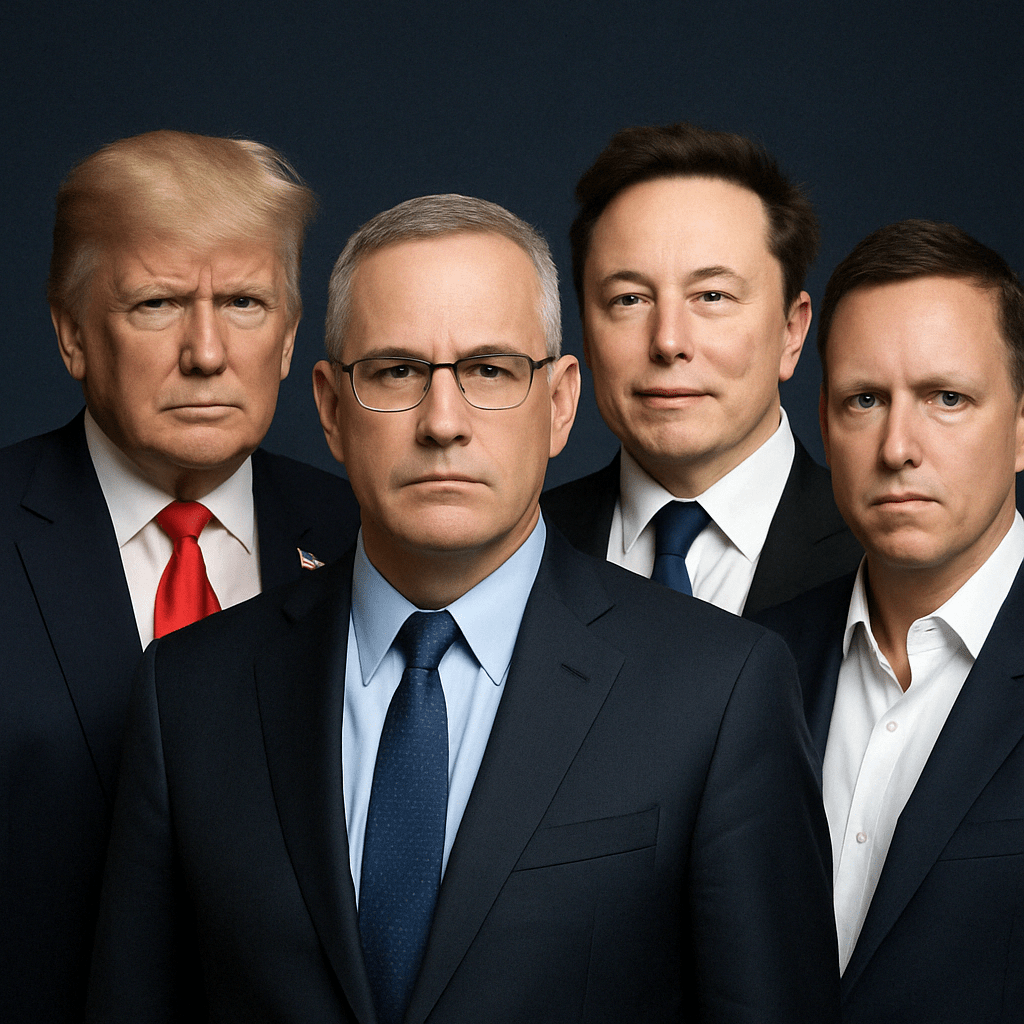
1. Structural Power Dynamics: Trump, Bessent, Musk, and the Federal Data Regime
The second Trump presidency has triggered not just a reconfiguration of political leadership, but a deeper, more enduring transformation of U.S. institutional infrastructure. At the heart of this shift is Treasury Secretary Scott Bessent, a figure whose quiet technocratic discipline now anchors the federal apparatus. While Trump delivers the ideological framing, Bessent ensures its implementation—translating volatile executive intent into structural policy.
As of 2025, Bessent functionally commands three nodes of federal power: the Treasury, the IRS, and the newly formed Department of Government Efficiency (DOGE), established via Executive Order 2025-01-20. While DOGE’s stated mission is improving administrative performance, its actual influence extends across federal staffing, IT modernization, and data governance.
In early March, Elon Musk attempted to install whistleblower Gary Shapley as IRS Commissioner, bypassing traditional Senate procedures by framing it as a temporary designation. However, within 48 hours, Bessent nullified the move—not by direct confrontation, but through a rerouting strategy: Shapley was reassigned to IRS-CI (Criminal Investigations) as Deputy Director and given the title of Reform Advisor. The maneuver avoided political spectacle while reasserting bureaucratic control. Notably, Shapley, who led investigations into the Hunter Biden tax case, remains a politically potent figure within conservative circles, adding to the delicacy of the situation.
This move exemplifies the new administrative choreography: Trump sets direction, Bessent consolidates power through structural realignment, DOGE implements reforms, and actors like Musk operate under conditional tolerance. Former IRS heads, such as Danny Werfel (resigned Jan 20, 2025), Douglas O’Donnell, and Melanie Krause, were all displaced not for incompetence but for procedural insubordination or hesitance to share data access with DOGE.
2. Structural Consolidation of Treasury, DOGE, and the IRS
DOGE’s creation marked a turning point. Initially positioned as a task force, it now exercises oversight authority on agency efficiency benchmarks, staff reorganizations, and budget optimization. As of Q1 2025, IRS senior leadership has been cut from 27 to 11, resulting in an estimated $2 billion in projected budgetary savings (DOGE, Efficiency Audit Report, 2025-03-31).
Central to this realignment is CTO Kashit Pandya, who holds dual roles as Chief Innovation Officer for DOGE and CIO for the IRS. Pandya’s role exemplifies the institutional merger of technological modernization and federal governance. Under his leadership, IRS legacy systems—heavily reliant on COBOL—are being refactored to enable real-time API access, blockchain-compatible auditing, and cross-departmental data mapping.
DOGE’s central goal is not merely “efficiency,” but data centralization under executive control. This is “executive compliance,” where the purpose of governance is to reinforce systemic loyalty and operational agility. The IRS, long considered a politically neutral back-office agency, is evolving into a proactive node of economic surveillance and enforcement.
3. The Strategic Entry of Palantir into the IRS Ecosystem
This is where Palantir’s role becomes both predictable and pivotal. The IRS’s transition from paper-led audits to algorithmic enforcement demands a partner capable of absorbing legacy data, applying machine learning, and interfacing with multiple layers of federal infrastructure.
Palantir’s Foundry platform excels in horizontal data integration, while Gotham (its more security-oriented cousin) offers predictive modeling and anomaly detection. In February 2025, a 3-day “IRS Modernization Hackathon”—featuring Palantir, DOGE, and IRS staff—served not only as a demonstration of technical feasibility but as a test of political and institutional permission. The event resulted in a working prototype capable of linking anonymized tax filings with immigration data, asset ownership trails, and payroll trends across states.
Despite ethical concerns about surveillance and data consolidation, Palantir neutralized opposition with its FedRAMP High certification (granted Dec 15, 2024), the highest cloud security rating for federal use. This achievement disarmed the Congressional Privacy Caucus, whose December 20th letter had previously criticized the firm’s involvement.
Moreover, Peter Thiel’s alignment with Trump and Musk adds another layer: Palantir is not just a vendor—it is a structurally embedded asset within the emerging state-tech nexus.
4. Winners and Losers: A New Profit and Control Map
The restructuring of IRS and Treasury systems reorders the profit landscape:
Winners
- Palantir Technologies (PLTR): Its software is positioned to become a permanent layer in federal data operations. The IRS contract—estimated at $600M over five years—will likely shift PLTR’s public-sector revenue share from 53% to over 70%, triggering a re-rating of its valuation metrics (EV/Sales from 9x to ~13x in bull case).
- DOGE Technocrats: With control over IT procurement, budget cuts, and agency audits, DOGE personnel are effectively gatekeepers of modernization funds.
- Trump-Bessent Bloc: Gains real-time fiscal visibility and control, enabling responsive fiscal positioning and targeted enforcement actions.
Losers
- Legacy IRS Officers: Those resistant to data-sharing protocols or unwilling to adapt to the AI audit model are demoted or quietly removed.
- Privacy-First Platforms: Without FedRAMP clearance or executive alignment, companies prioritizing encryption and decentralization are structurally excluded.
- Opposition-Aligned Tech Firms: Risk being labeled inefficient, partisan, or noncompliant—effectively disqualifying them from federal RFPs.
In this context, the phrase “follow the money” is inadequate. One must now follow who builds, controls, and licenses the pipes through which money, data, and policy flow.
5. Macro Implications: Real-Time Tax Data and Rate Policy
Bessent’s design has profound implications for fiscal and monetary policy. With IRS systems integrated into Treasury dashboards, real-time tax inflows (via the Treasury Daily Statement API) will shape short-term funding strategies. For example, if W-2 tax withholding data shows early underperformance, TGA drawdowns may trigger expedited short-dated T-bill issuance, altering yield curve dynamics.
This feedback loop reorients the role of the IRS—from post-factum enforcement to fiscal signal generator. The CBO’s dynamic scoring models may soon be replaced or augmented by machine-fed Treasury forecasts, incorporating Palantir-derived analytics. This alters the Fed’s perception of inflation risk, enabling more aggressive or anticipatory rate decisions.
The era of lagging indicators is fading. In its place comes surveillance-based forecasting—a regime where behavior, not just economic output, dictates macro policy.
6. Investment Strategy: Structural Advantage Beats Narrative
Given this backdrop, investors must stop reacting to surface headlines and begin analyzing infrastructural positioning.
Buy:
- Palantir (PLTR): Not a software vendor but a compliance infrastructure layer. As Gotham merges with federal workflows, its churn risk falls while pricing power grows.
- GovTech integrators with FedRAMP High & DoD credentials: Firms like Carahsoft or Booz Allen may play intermediary roles in scaling federal modernization.
Avoid:
- Legacy Fintech: Especially platforms optimizing for user privacy or open-banking compliance. Their business models are misaligned with a regime prioritizing visibility and command.
- Decentralized Finance (DeFi): While still innovative, DeFi lacks the institutional scaffolding to participate in a centralized enforcement paradigm.
Investors must understand: The winning firms are not necessarily the most innovative, but those structurally nearest to the enforcement engine.
Final Reflection: The Architect Behind the Machine
When Bessent remarked, “I want to be part of the global monetary restructuring,” it was easy to misinterpret. He is not competing with central bankers—he is reshaping the terrain they operate on. His vision is not ideological but architectural: he is engineering the compliance chassis upon which new financial systems will be built.
From programmable tax enforcement to predictive liquidity controls, the infrastructure now being laid at the Treasury and IRS will define the next decade of fiscal governance. And as this infrastructure scales globally—through vendor licensing, IMF technical frameworks, and bilateral digital tax treaties—Bessent’s model may become the benchmark.
In a future defined by auditability and obedience, whoever owns the compliance stack owns the monetary order.




 HOHO-ECONOMICUS Insight
Leave a comment